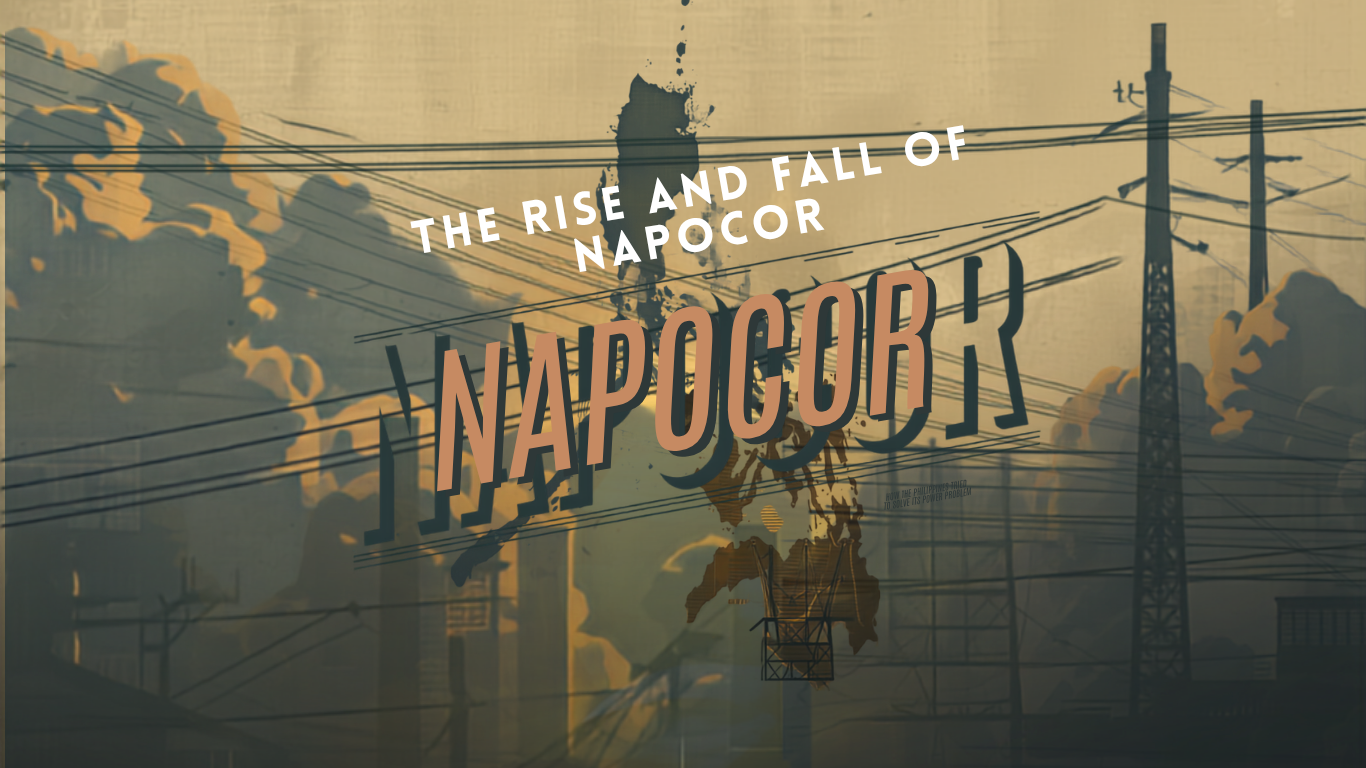
Before Privatization, There Was NAPOCOR
When Filipinos complain about expensive electricity today, the conversation often turns to private companies, fuel prices, taxes, or electricity distributors.
But before today’s electricity market existed, there was another giant at the center of the Philippine power industry:
The National Power Corporation — NAPOCOR or NPC.
For decades, NAPOCOR was the government’s primary instrument for developing the country’s electricity supply.
Its story is important because you cannot fully understand today’s electricity prices without understanding what happened to NAPOCOR.
And the story begins in 1936.
1936: The Birth of NAPOCOR
The National Power Corporation was created on November 3, 1936, under Commonwealth Act No. 120.
Its original mission was connected to the development of the country’s power resources.
Over time, NAPOCOR became much more than just another government corporation.
It became a central player in generating electricity and developing the transmission system that connected power producers to consumers.
According to NAPOCOR’s historical account, from its creation through the late 1980s, electricity generation and transmission were largely vertically integrated, centrally controlled, and government-owned through NPC.
In simple terms:
One government-controlled organization had a very large role in producing and moving electricity around the country.
That system had advantages.
But it also created enormous financial responsibilities.
The Philippines Needed More Electricity
As the Philippines became more industrialized and its population increased, electricity demand grew.
Factories needed power.
Businesses needed power.
Homes needed power.
Hospitals, schools, transportation systems, telecommunications, and eventually the digital economy all depended on reliable electricity.
The government therefore had to make a difficult choice:
Build more power plants—or risk not having enough electricity.
Building power plants, however, is expensive.
It requires:
- Land
- Engineering
- Construction
- Fuel
- Transmission infrastructure
- Maintenance
- Skilled workers
- Financing
And the Philippines needed to do this while also expanding electricity access to more parts of the country.
The Problem With Building Power Too Quickly
Imagine running a household where your income is limited but you suddenly need to buy a house, a vehicle, appliances, and equipment because your family is growing.
You can borrow money to pay for everything.
But eventually, the loans have to be repaid.
The same basic principle applies to infrastructure.
The Philippines needed enormous investments in electricity infrastructure.
Government-owned NAPOCOR became responsible for much of this development.
But the more infrastructure it built and the more obligations it accumulated, the greater the financial pressure became.
Then Came the Power Crisis
The country’s electricity problems became especially visible during the late 1980s and early 1990s.
Power shortages and rotating brownouts became a major national problem.
For ordinary Filipinos, the issue was not an economic theory.
It was simple:
There was not enough reliable electricity.
Businesses could not operate normally.
Factories experienced interruptions.
Households experienced brownouts.
Economic activity suffered.
The government needed a rapid solution.
Enter the Independent Power Producers
One major response was to allow Independent Power Producers (IPPs) to participate in electricity generation.
Instead of relying entirely on government-owned generation facilities, private investors could build and operate power plants under contractual arrangements.
This helped the country add generating capacity more quickly.
And it worked in an important sense:
The Philippines was able to increase available power capacity and reduce the immediate threat of severe shortages.
But there was another side to the story.
Many of these arrangements involved long-term contractual obligations.
And those obligations would eventually become part of the financial story of the Philippine power sector.
The Peso and Dollar Problem
There is another lesson hidden inside the history of Philippine electricity:
Electricity is connected to the global economy.
Some energy-related contracts and financing arrangements were linked to foreign currencies, particularly the U.S. dollar.
When the Philippine peso weakens against the dollar, obligations denominated in dollars can become more expensive when converted into pesos.
This became especially important during periods of economic and currency instability.
The lesson is simple:
The price of electricity in the Philippines isn’t determined only by what happens inside a power plant.
It can also be affected by:
Fuel prices + exchange rates + financing + contracts + demand + infrastructure.
The Asian Financial Crisis Made Things Worse
Then came the 1997 Asian Financial Crisis.
Currencies across the region came under pressure.
The Philippine peso depreciated significantly.
For the power sector, this created another financial challenge.
Existing obligations and contracts became more expensive when measured in pesos.
At the same time, the government was dealing with broader economic problems.
The electricity sector could not be separated from the country’s financial condition.
NAPOCOR Was Carrying a Heavy Burden
By this point, NAPOCOR was dealing with enormous financial obligations.
The problem was no longer simply:
“How do we generate enough electricity?”
The question had become:
“How do we maintain and expand the electricity system without allowing the government’s financial burden to become unsustainable?”
This was one of the major pressures behind the eventual restructuring of the Philippine electricity industry.
And that restructuring would fundamentally change how electricity was produced, transmitted, distributed, and sold.
2001: The Big Change
In 2001, Congress passed Republic Act No. 9136, better known as the Electric Power Industry Reform Act or EPIRA.
This law became one of the most important turning points in Philippine energy history.
EPIRA aimed to restructure the electricity industry, introduce competition in generation, encourage private-sector participation, establish a regulatory framework, and address the financial obligations associated with NAPOCOR.
The law divided the industry into four major sectors:
1. Generation
Companies produce electricity.
2. Transmission
Electricity is transported through the high-voltage transmission network.
3. Distribution
Electricity is delivered to homes and businesses.
4. Supply
Electricity is supplied to qualified consumers under the market structure established by the law.
This was a fundamental change from the old vertically integrated model.
What Happened to NAPOCOR?
EPIRA did not simply eliminate NAPOCOR.
Instead, it fundamentally changed its role.
The law created the Power Sector Assets and Liabilities Management Corporation (PSALM).
PSALM was tasked with taking ownership of NPC’s generation assets and liabilities and managing the privatization and disposition of assets as part of the restructuring process.
The law also provided for the privatization of many NPC generation assets, real estate, and existing Independent Power Producer contracts.
In other words:
The Philippines moved from a predominantly government-owned electricity generation system toward a more market-oriented and privately participated system.
That transformation is one of the biggest reasons today’s electricity market looks very different from the system your parents or grandparents experienced.
Did Privatization Make Electricity Cheaper?
This is where the conversation becomes complicated.
EPIRA was designed with affordability, competition, reliability, transparency, and private investment among its objectives.
The law itself declares a policy of ensuring quality, reliability, security, and affordability of electricity, while promoting transparent and reasonable prices through competition.
But the existence of a competitive electricity market does not automatically guarantee cheap electricity.
Why?
Because the final price of electricity depends on many factors.
For example:
Generation cost
Transmission cost
Distribution cost
System charges
Taxes and other government-mandated charges
Your electricity bill
And behind generation itself are factors such as:
- Coal prices
- Natural gas prices
- Renewable energy costs
- Imported fuel
- Exchange rates
- Plant efficiency
- Maintenance
- Financing
- Supply and demand
So when your electric bill increases, there is rarely just one person—or one company—to blame.
There is a system behind the bill.
The NAPOCOR Lesson
The history of NAPOCOR teaches us something important.
Government ownership has advantages.
Private investment has advantages.
But both systems have risks.
A government-controlled system can accumulate enormous financial obligations if infrastructure investment and contracts become unsustainable.
A market-oriented system can attract private capital and encourage competition, but consumers can still face high prices when generation costs, fuel prices, market conditions, infrastructure limitations, or regulatory charges remain high.
The real question is therefore not simply:
Government or private sector?
The more important question is:
“How do we build an electricity system that is reliable, competitive, transparent, and affordable?”
Why This History Still Matters Today
When we look at our electric bill in 2026, we are looking at the result of decisions made over many decades.
The power plants operating today did not appear overnight.
The transmission network did not appear overnight.
The contracts, regulations, institutions, and market structures did not appear overnight.
Today’s electricity market is essentially the result of a long chain of decisions.
And that is why solving the country’s high electricity prices will also require looking at the system as a whole.
The Bigger Question
NAPOCOR was created to help build the country’s electricity system.
Decades later, the government decided that the industry needed a major structural transformation.
EPIRA was intended to bring competition, private capital, efficiency, and a more sustainable electricity sector.
But more than two decades later, Filipinos are still asking:
Why is electricity still so expensive?
That question brings us to the next chapter.
Because after NAPOCOR came EPIRA.
And EPIRA didn’t simply change who owned the power plants.
It changed the rules of the game.
Next Post: EPIRA Explained
In Part 3, we’ll take a closer look at the law that changed Philippine electricity forever:
EPIRA: The Law That Changed How Filipinos Buy Electricity
We’ll explain:
- What EPIRA actually says
- Why the law was created
- What happened to NAPOCOR
- What PSALM does
- What happened to the transmission system
- How competition was introduced
- What WESM is
- Where electricity prices come from
- And the big question:
Did EPIRA solve the problem—or create new challenges?
Stay tuned.
Research & References
This series uses publicly available government documents and reputable research materials to examine the Philippine electricity sector.
Primary government reference: National Power Corporation — Historical Background
Legal reference: Republic Act No. 9136 — Electric Power Industry Reform Act of 2001
Additional research reference: MSN Philippines — Explainer: Why is electricity expensive in the Philippines?
The objective of this series is to explain the issue in an accessible and balanced way—not to promote or attack any political party, company, government agency, or individual.
Share Your Thoughts
What do you think is the biggest reason electricity is expensive in the Philippines?
A. Fuel prices
B. Government policies
C. Private companies
D. Transmission and infrastructure
E. Taxes and additional charges
F. A combination of all of them
Comment your answer below.
#Philippines #EnergyPH #Electricity #ElectricBill #NAPOCOR #PowerCrisis #EPIRA #EnergySecurity #PhilippineEconomy #CostOfLiving #Infrastructure #PowerIndustry #EnergyExplained #DidYouKnow #PhilippineEnergy


Leave a Reply