Introduction: Cybersecurity Is Everyone’s Responsibility
Every day, Filipinos rely on websites, online banking, e-commerce platforms, government portals, mobile applications, and digital payment systems. Behind many of these services are software developers, IT administrators, cloud engineers, and other technology professionals who keep digital services running.
But what happens when the technology we trust contains a serious security weakness?
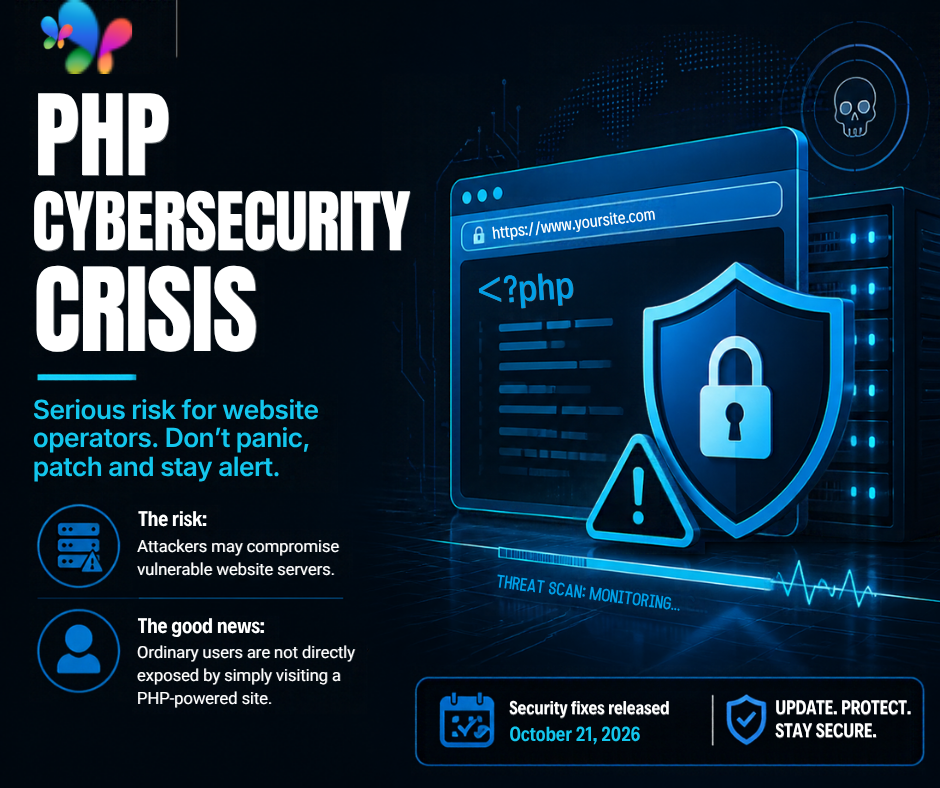
The recent PHP cybersecurity crisis provides a timely reminder. In October 2026, critical vulnerabilities in PHP prompted urgent warnings to developers, system administrators, and hosting providers. The vulnerabilities could potentially allow attackers to execute malicious code on affected servers. The Philippine Department of Information and Communications Technology (DICT), through CERT-PH, urged organizations to identify affected environments and apply the appropriate security updates. Source: Newsbytes.PH.
PHP is widely used in website development, including in platforms and applications that power online services. When a vulnerability affects a widely deployed technology, the impact can extend beyond the developers who maintain it.
The real issue is not simply that a programming language has a security flaw. It is whether the organizations using that technology can identify, fix, and manage the risk before it harms people.
As a software developer and IT professional, I believe this is an opportunity to examine our responsibilities, improve our practices, and contribute to a more secure digital Philippines.
1. Why Should We Be Concerned About the PHP Cybersecurity Crisis?
First, let us clarify something: PHP is a programming language, not the Philippine peso. It is used to build the server-side functionality of websites and web applications.
A serious vulnerability in PHP or another widely used software component can create risks for systems that depend on affected versions or configurations.
Depending on the vulnerability and the environment, successful exploitation may lead to unauthorized access, data exposure, website modification, or service disruption.
Imagine a small business operating an online store. Its website collects customer information and processes orders. If its hosting environment remains vulnerable, attackers may find an opportunity to compromise the website or access sensitive information.
Now imagine the same weakness affecting a system that supports public services.
The consequences can extend beyond financial losses. Customers may lose trust, employees may lose access to critical systems, and organizations may face recovery costs, reputational damage, and potential privacy obligations.
However, we should not assume that every PHP website is vulnerable or that every organization using PHP has been compromised. Risk depends on the affected versions, system configuration, exposure, and whether appropriate security measures have been implemented.
The correct response is informed urgency, not panic.
2. The Philippine Cybersecurity Problem Goes Beyond Software Vulnerabilities
The PHP incident is part of a broader challenge: protecting people and organizations as more activities move online.
According to the Philippine Statistics Authority’s report released in June 2026, based on its 2024 National ICT Household Survey, 62.5% of ICT device users surveyed experienced at least one cybersecurity incident during 2024. SMS fraud was the most prevalent reported type, affecting 57.1% of people who experienced cybersecurity incidents. Only 1.9% of those who experienced such incidents reported them to authorities.
The figures highlight two important concerns: Filipinos face substantial exposure to digital threats, and incident reporting remains limited. Source: Philippine Statistics Authority.
This means cybersecurity is not exclusively a problem for large corporations or government agencies. It affects ordinary workers, students, families, online sellers, freelancers, and small businesses.
For IT professionals, this presents a wider responsibility. We must secure the technology we build, but we must also help people understand how to use it safely.
A secure application is valuable. An informed user is valuable, too.
We need both.
3. How Software Developers Can Make a Difference
Software developers are in a position to prevent many security weaknesses before applications reach production.
Security should not be treated as a separate task that begins only after an application has been built. It should be part of the entire software development lifecycle.
Here are practical ways developers can contribute.
A. Practice secure coding
Developers should understand common vulnerabilities, validate inputs, implement proper authentication and authorization, protect sensitive information, and handle errors without exposing internal system details.
For web applications, important practices include:
- Use parameterized queries to reduce SQL injection risks.
- Validate and sanitize inputs according to their intended use.
- Enforce authorization checks on the server, not just in the user interface.
- Protect sessions and implement appropriate security controls.
- Store passwords using established password-hashing methods.
- Avoid placing passwords, API keys, and other secrets in source code.
- Use secure configurations and appropriate encryption.
These practices are not optional extras. They are part of responsible software engineering.
B. Keep dependencies and runtimes updated
Modern applications depend on programming languages, frameworks, libraries, plugins, operating systems, and server software.
A developer may write secure application code while the underlying runtime or a third-party component remains vulnerable.
That is why developers must maintain an inventory of software dependencies, monitor security advisories, and prioritize updates based on risk.
For PHP applications, this means verifying the deployed PHP version, checking official security advisories, determining whether the environment is affected, and installing the appropriate supported updates.
Updating software should also include testing, backups, rollback procedures, and verification that the fix has been applied successfully.
A patch that is available but never installed does not protect a production system.
C. Integrate security into DevOps and CI/CD
For DevOps engineers and software delivery teams, security can be built into automated development pipelines.
Practical measures include:
- Automated dependency and vulnerability scanning.
- Static application security testing (SAST).
- Secret detection in source-code repositories.
- Container and infrastructure configuration scanning, where applicable.
- Automated tests for authentication and access-control rules.
- Controlled deployment approvals for high-risk changes.
- Monitoring and alerts after deployment.
The goal is to identify problems earlier, reduce repetitive manual work, and make secure delivery part of the normal development process.
Automation does not eliminate the need for human judgment. It helps teams detect issues consistently and respond faster.
D. Design for failure and recovery
Even well-maintained systems can experience security incidents, hardware failures, or service outages.
Developers should work with infrastructure and operations teams to ensure that applications have reliable backups, documented recovery procedures, appropriate access controls, and useful audit logs.
Backups should be protected against unauthorized modification and periodically tested through restoration exercises.
A backup that cannot be restored when needed is not a reliable recovery strategy.
Our objective should not only be to prevent attacks. We should also minimize damage and restore services quickly when prevention fails.
4. What IT Administrators, DevOps Engineers, and System Owners Must Improve
Security is not the developer’s responsibility alone. Applications operate within an environment that includes servers, networks, cloud services, databases, identities, and operational processes.
IT administrators and system owners must take responsibility for the complete environment.
First, establish visibility. Organizations need to know which systems they own, what software they run, which versions are deployed, who maintains them, and which services are exposed to the internet.
Second, prioritize remediation. Not every vulnerability carries the same risk. Teams should consider severity, actual exposure, available exploits, business impact, and the sensitivity of affected data when deciding what to fix first.
Third, improve monitoring. Server and application logs, unusual login activity, unexpected file changes, suspicious outbound traffic, and abnormal application behavior can help teams identify potential compromise. Monitoring must be accompanied by clear procedures for investigating alerts.
Fourth, prepare for incidents. Organizations should know who is responsible for containment, technical investigation, stakeholder communication, recovery, and any required reporting. They should practice these procedures rather than waiting for a real attack.
Finally, establish accountability. Security findings need an owner, a remediation deadline, and evidence that the issue has been resolved.
In the Philippines, DICT has also strengthened its focus on government cybersecurity. In September 2026, the Philippine News Agency reported a DICT directive requiring covered government agencies to conduct annual cybersecurity testing, including vulnerability assessment and penetration testing (VAPT), with additional testing requirements in certain circumstances.
This reinforces an important principle: security testing must lead to corrective action, not merely produce a report.
5. What Businesses and Organizations Need to Change
Many organizations, especially small and medium-sized enterprises (SMEs), operate with limited budgets and small IT teams.
Some postpone software upgrades because their applications are old, their operations cannot easily tolerate downtime, or they lack in-house security expertise.
These are real constraints, but ignoring vulnerabilities can create even greater costs.
Organizations can begin with a practical security improvement plan.
- Identify critical assets. List websites, applications, databases, hosting accounts, business email systems, and services that handle customer or employee information.
- Assess exposure. Determine which systems are publicly accessible, which software versions they use, and which components need urgent attention.
- Apply security updates. Follow vendor guidance, test changes where possible, and document remediation.
- Protect privileged accounts. Use multifactor authentication, least-privilege access, unique credentials, and secure secret storage.
- Test backups and recovery. Confirm that essential business data can be restored within an acceptable period.
- Train employees. Teach staff how to recognize phishing, fraudulent messages, suspicious links, and social-engineering attempts.
- Review security regularly. Schedule maintenance, review access rights, monitor important systems, and conduct risk-based security assessments.
For small businesses without dedicated security staff, engaging a qualified IT service provider can help establish these basic controls.
Cybersecurity does not always require an expensive enterprise platform. It requires a realistic plan, consistent execution, and clear ownership.
6. How IT Professionals Can Help Ordinary Filipinos
Our contribution should extend beyond our employers and clients.
As technology professionals, we can help bridge the gap between technical security and public understanding.
We can publish accessible articles explaining current threats without creating unnecessary fear. We can teach families how to recognize scam messages, enable multifactor authentication, and protect their accounts.
We can volunteer to conduct basic digital safety workshops for schools, community groups, and small businesses. We can help SMEs understand the importance of software updates, secure backups, privacy protection, and access management.
We can also encourage responsible incident reporting and direct affected individuals toward appropriate official reporting channels.
Another opportunity is to create practical, affordable tools that help people and businesses improve their security.
Examples include:
- A simple website security maintenance checklist.
- An automated reminder system for software and plugin updates.
- A basic security awareness course for employees.
- A small-business backup verification service.
- A website maintenance package that includes vulnerability checks and remediation coordination.
- Educational resources explaining phishing, identity theft, and data privacy in plain Filipino or English.
These initiatives combine technical skills with real-world community needs.
For developers and IT professionals who want to build a side business, cybersecurity services can also create meaningful value. The important distinction is to offer services within our competence, clearly define the scope, obtain authorization before testing systems, and avoid promising absolute protection.
We can turn our technical knowledge into both a livelihood and a contribution to public safety.
7. What We Need to Improve as an IT Industry
Technology professionals must also examine the weaknesses in our own practices.
Security must be part of the development culture
Organizations should stop treating security as something to address only after a breach. Product owners, developers, testers, infrastructure teams, and management must share responsibility for reducing risk.
Continuous learning must become routine
Threats evolve, software changes, and new vulnerabilities emerge. IT professionals should regularly study secure coding, cloud security, identity management, vulnerability assessment, incident response, and relevant security advisories.
We do not all need to become penetration testers. However, every technology professional should understand the security risks associated with their role.
Technical debt must be managed
Legacy systems often support essential business operations. Replacing them immediately may be unrealistic, but leaving them undocumented and unmaintained is dangerous.
Organizations should document legacy dependencies, identify unsupported components, establish compensating controls where necessary, and develop a realistic modernization roadmap.
Leadership must support security
IT teams cannot solve every problem without sufficient time, budget, access, and management support.
Business leaders must recognize that cybersecurity is an investment in operational continuity, customer trust, and organizational resilience—not simply an IT expense.
Collaboration must improve
Developers, IT administrators, security professionals, business owners, educators, and government agencies need to share knowledge and coordinate responses.
Cybersecurity becomes stronger when lessons from incidents are translated into better standards, safer products, improved processes, and more informed users.
8. A Practical 30-Day Cybersecurity Action Plan for IT Professionals
We do not need to wait for a major cyberattack before taking action.
Here is a simple plan that developers and IT teams can start implementing.
Week 1: Review
- Inventory the applications and systems you maintain.
- Check software versions and relevant security advisories.
- Identify exposed services and critical dependencies.
- Review privileged accounts and access permissions.
Week 2: Fix
- Prioritize critical vulnerabilities.
- Apply supported patches and security updates.
- Remove unnecessary accounts, services, and permissions.
- Verify that secrets are not exposed in source code or configuration files.
Week 3: Strengthen
- Review backup and restoration procedures.
- Improve logging and alerting for critical systems.
- Add security checks to development and deployment workflows.
- Document incident-response responsibilities.
Week 4: Educate and measure
- Share a short cybersecurity lesson with colleagues or customers.
- Conduct a basic phishing-awareness or account-security session.
- Record unresolved risks and assign owners.
- Set a schedule for recurring reviews and remediation.
This is only a starting point, not a complete security program. Organizations handling sensitive or critical systems may need more extensive assessments and specialized expertise.
The objective is to establish a sustainable habit of identifying risks, fixing weaknesses, and learning from the results.
Conclusion: Build Technology That People Can Trust
The PHP cybersecurity crisis reminds us that a weakness in widely used software can become a problem for organizations and people far beyond its original developers.
But the lesson should not be that technology is inherently unsafe. It should be that technology must be developed, maintained, and operated responsibly.
As software developers, DevOps engineers, IT administrators, and technology leaders, we have the opportunity to make a measurable difference.
We can write more secure code. We can automate vulnerability detection. We can maintain systems properly. We can improve backup and recovery processes. We can educate users and help small businesses adopt practical security controls.
We must also acknowledge that technology alone cannot eliminate every threat. Strong cybersecurity requires capable people, responsible leadership, continuous improvement, and informed users.
For me, being an IT professional means more than delivering applications, maintaining servers, or keeping systems online. It also means understanding how our work affects the people who depend on those systems.
Every secure application, every timely patch, every protected account, and every person we educate contributes to a safer digital Philippines.
We may not be able to stop every cyberattack, but we can make it harder for attackers to succeed—and help our communities recover when incidents occur.
That is how we turn technical expertise into meaningful impact.
References and further reading
- DICT cybersecurity unit warns of critical PHP flaws — Newsbytes.PH, October 24, 2026
- Philippine Statistics Authority — 2024 National ICT Household Survey cybersecurity findings, released June 16, 2026
- Philippine News Agency — DICT mandates annual cyber testing for government agencies, September 18, 2026
Disclaimer: This article is for general awareness and educational purposes. Organizations should consult official security advisories and qualified professionals when assessing specific systems or responding to suspected compromise.
#Cybersecurity #PHP #SoftwareDevelopment #SecureCoding #DevOps #ITProfessionals #DataPrivacy #CyberResilience #DigitalPhilippines #InfoSec #WebDevelopment #CloudSecurity #CyberAwareness #TechForGood #DigitalTransformation
Leave a Reply