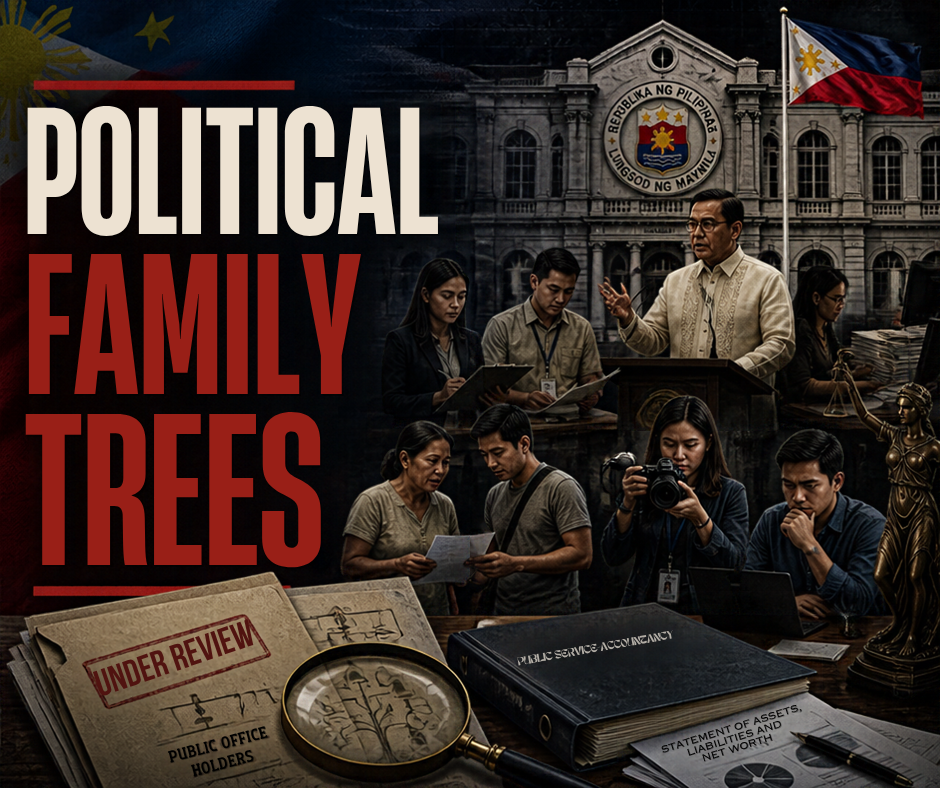
When we talk about political dynasties, we often focus on the politician who is currently holding office.
But there is another way to understand political power.
Follow the family tree.
A politician may be succeeded by a child. A spouse may run for another position. A sibling may become a congressman while another becomes a mayor.
Sometimes, several family members hold different government positions at the same time.
Political researchers commonly describe two patterns:
1. Thin dynasty – Political succession
A family member takes over a position previously held by another family member.
Example:
Father → Daughter → Son.
2. Fat dynasty – Simultaneous political control
Two or more relatives hold different elected positions at the same time.
Example:
Father = Governor
Mother = Mayor
Son = Congressman
Daughter = Councilor.
These descriptions help researchers understand how political influence moves between generations.
Source: OpenHalalan – Philippine election and dynasty dataset.
Understanding the degree of family relationships
Family relationships are important when identifying political dynasties.
Here are simple examples of degrees of consanguinity, which describe blood relationships:
| Relationship | Degree |
|---|---|
| Parent and child | First degree |
| Grandparent and grandchild | Second degree |
| Brother and sister | Second degree |
| Uncle/aunt and nephew/niece | Third degree |
| First cousins | Fourth degree |
Marriage also creates relationships by affinity. For example, a husband and wife may both enter public office.
The proposed anti-dynasty legislation has used different definitions and coverage rules. Therefore, a family tree does not automatically mean that every member is legally prohibited from running.
Example 1: The Marcos family
Simplified family tree
Ferdinand Marcos Sr. + Imelda Romualdez Marcos
↓
- Ferdinand “Bongbong” Marcos Jr.
- Imee Marcos
- Irene Marcos
- Aimee Marcos
Bongbong Marcos + Liza Araneta-Marcos
↓
- Ferdinand Alexander “Sandro” Marcos
- Joseph Simon Marcos
- William Vincent Marcos
Political connections:
- Ferdinand Marcos Sr. – Former President.
- Imelda Marcos – Former First Lady and former elected representative.
- Ferdinand Marcos Jr. – Former governor, congressman, senator, and President.
- Imee Marcos – Former governor, congresswoman, and senator.
- Sandro Marcos – Elected representative of the first district of Ilocos Norte.
The family tree demonstrates political involvement across generations.
It does not mean every family member has the same political record or responsibility.
Official family and service information: Philippine Embassy – President Ferdinand Marcos Jr..
Example 2: The Duterte family
Simplified family tree
Rodrigo Duterte + Elizabeth Zimmerman
↓
- Paolo Duterte
- Sara Duterte
- Sebastian Duterte
Political connections:
- Rodrigo Duterte – Former Davao City mayor and former President.
- Sara Duterte – Former Davao City mayor and Vice President.
- Paolo Duterte – Former Davao City vice mayor and elected congressman.
- Sebastian Duterte – Elected Davao City mayor.
This family illustrates both succession and simultaneous political participation.
The Duterte family has held important positions in Davao City and national government.
Example 3: The Villar family
Simplified family tree
Manuel Villar + Cynthia Villar
↓
- Mark Villar
- Camille Villar
- Paolo Villar
Political connections:
- Manuel Villar – Former congressman, senator, and Senate President.
- Cynthia Villar – Former congresswoman and senator.
- Mark Villar – Former Department of Public Works and Highways secretary and elected senator.
- Camille Villar – Former congresswoman and elected senator in 2025.
The family has participated in national and local politics, particularly in Las Piñas.
Example 4: The Cayetano family
Simplified family tree
Renato “Rene” Cayetano + Sandra Schramm Cayetano
↓
- Alan Peter Cayetano
- Pia Cayetano
- Rene Carl Cayetano
- Lino Edgardo Cayetano
Political connections:
- Alan Peter Cayetano – Former congressman and senator.
- Pia Cayetano – Senator and former congresswoman.
- Lani Cayetano – Alan Peter Cayetano’s wife and elected Taguig mayor.
The relationship between Alan Peter and Pia is a sibling relationship. Their political participation is a clear example of a family having more than one national elected official.
Official reference: Senate biography of Alan Peter Cayetano.
Why family trees matter
A family tree helps voters identify relationships that may not be obvious during election campaigns.
A candidate may have a different surname because of marriage. Another may use a middle name connected to a political family.
This is why simply searching by last name is not enough.
Researchers need to compare:
- Birth and marriage relationships.
- Official biographies.
- Election history.
- Certificates of candidacy.
- Government service records.
- Reliable investigative reporting.
The BetterGov.ph dynasty tracker and OpenHalalan dataset provide useful tools for checking political histories. However, surname matching should not be treated as final proof of family relationships.
Final thought
A family member has the same right as any qualified Filipino to seek public office.
But voters also have the right to ask why several members of the same family are seeking control of different government positions.
Political office is public responsibility, not private family property.
#PoliticalFamilyTree #PhilippinesPolitics #PoliticalDynasties #Marcos #Duterte #Villar #Cayetano #PoliticalAwareness #GoodGovernance #PublicService





Leave a Reply