The Philippines is officially in its digital age — or at least, that’s what the headlines say.
From GCash, Maya, online banking, Buy Now Pay Later (BNPL) apps, to digital loans that promise “instant approval,” Filipinos are now just a few taps away from sending money, paying bills, or borrowing cash.
But behind the convenience is a growing truth many Filipinos silently experience:
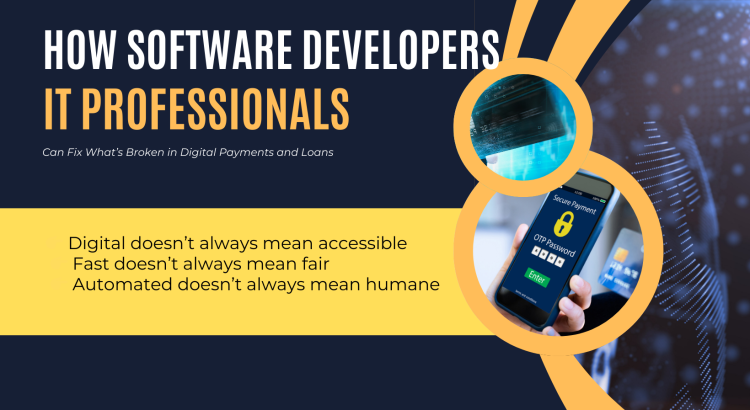
👉 Digital doesn’t always mean accessible
👉 Fast doesn’t always mean fair
👉 Automated doesn’t always mean humane
And this is where software developers and IT professionals can — and should — make a difference.
📲 The Current State of Digital Transactions in the Philippines
Digital payments and lending platforms have exploded, especially after the pandemic. According to industry data, millions of Filipinos now rely on cashless transactions, especially those without access to traditional banking.
What’s working:
- Faster peer-to-peer payments
- Wider adoption of e-wallets
- Easier access to micro-loans
- Digital onboarding without physical branches
What’s not:
- Confusing loan terms and hidden fees
- Poor UX for non-tech users
- Weak data privacy protection
- Aggressive and sometimes abusive collection systems
- Limited digital literacy
The problem is not the technology itself —
the problem is how it’s designed, implemented, and governed.
💻 Where Software Developers and IT Professionals Come In
As people working in Information Technology, we are not just builders of systems —
we are architects of digital behavior.
Every line of code affects:
- How people trust a platform
- How they understand financial obligations
- How fairly they are treated by algorithms
1️⃣ Designing Ethical and Inclusive Systems
Many fintech apps are built for speed and scale, not for understanding.
Developers can help by:
- Building clear loan breakdowns (interest, penalties, timelines)
- Implementing human-readable contracts, not legal walls of text
- Adding cool-down warnings before users accept loans
- Designing apps for low-end devices and slow internet
Good UX is not just good design — it’s financial protection.
2️⃣ Improving Transparency Through Better Software Logic
Hidden charges are often not “hidden” by intention —
they’re hidden by bad system logic and poor data presentation.
IT professionals can:
- Create real-time computation previews
- Show total payable amount upfront
- Implement regulation-aligned disclosures
- Log transparent audit trails for disputes
This is where backend developers, system analysts, and DevOps engineers can enforce fairness at scale.
3️⃣ Protecting User Data in a High-Risk Digital Economy
Filipinos are among the most active internet users —
and sadly, among the most exposed to data misuse.
As IT professionals, we can:
- Enforce privacy-by-design
- Apply zero-trust security models
- Encrypt sensitive financial data properly
- Prevent data leaks used for harassment or scam operations
In digital lending, data misuse is not just a bug — it’s a life problem.
⚠️ What Still Needs Serious Improvement
Despite progress, major gaps remain.
🚧 Digital Literacy Gap
Many users don’t fully understand:
- Interest compounding
- Penalty triggers
- Credit score consequences
Technology should educate, not confuse.
🚧 Weak Regulation-to-Code Translation
Laws exist, but they are often:
- Poorly implemented in systems
- Not reflected in automated workflows
- Ignored in algorithmic decisions
Developers can help bridge law + logic + code.
🚧 Over-Automation Without Accountability
Bots collect debts.
Algorithms reject loans.
Systems block accounts.
But who explains?
Who listens?
Who fixes?
Automation must always include human override paths.
🌱 The Opportunity: Tech as a Tool for Social Impact
The Philippines doesn’t just need more apps.
It needs better systems with Filipino realities in mind.
Imagine:
- Loan apps that pause penalties during disasters
- Payment systems that work offline-first
- Credit scoring that considers real-life income patterns
- Fintech platforms that respect human dignity
These are not impossible dreams —
they are software design choices.
👨💻 A Message to Fellow IT and Software Professionals
If you work in tech, remember this:
You are not just coding features —
you are shaping how Filipinos survive, borrow, pay, and recover.
Whether you are a:
- Software Developer
- DevOps Engineer
- System Analyst
- QA Tester
- Product Designer
- Cybersecurity Professional
You have the power to:
- Question unfair logic
- Improve broken flows
- Advocate for ethical systems
- Build technology that serves, not exploits
🚀 Moving Forward: Building a Fair Digital Philippines
The digital age is here —
but digital justice is still catching up.
Let’s build:
- Transparent systems
- Inclusive platforms
- Secure infrastructures
- Human-centered automation
Because in the Philippines, technology is not just about innovation —
it’s about survival, trust, and hope.
🔖 Trending & Hashtag-Ready Keywords
#PhilippineDigitalAge #FintechPH #DigitalPaymentsPH #DigitalLoansPH
#SoftwareDeveloperPH #ITProfessionalsPH #TechForGood
#FinancialInclusion #EthicalTech #UXMatters #DataPrivacyPH
#CashlessPH #DigitalTransformationPH #CodeWithPurpose